A lot of people get stuck here for years.
They know what a decent breakfast looks like. They know eating vegetables is probably a good idea. They know that grabbing biscuits at 4 pm because work was annoying is not really hunger. None of this is a mystery.
And still, at the actual moment when food choices happen, they do something else.
It is easy to turn that into a character judgement. Lazy. Undisciplined. No willpower. Not serious enough. I do not think that is usually what is going on.
Most of the time, the issue is much more ordinary than that. You are tired. You are stressed. You are busy. You left it too long and now you are starving. The easy food is visible and the better option needs chopping, cooking, cleaning up, and about 20 minutes you do not feel like giving.
That gap between knowing and doing is where most people live.
Knowing is not the hard part
If information fixed eating habits, most of us would be sorted already.
People often assume they need a better meal plan, more nutrition facts, stricter rules, a stronger reason, more motivation. Sometimes that helps a bit. Usually not for long.
Because food decisions do not happen in a quiet little lab where you calmly review your values and make rational choices. They happen when you have had a bad night of sleep, your kid is asking you something while you are trying to answer an email, and there is half a baguette on the counter. Or when you get home at 8 pm and the thought of cooking anything sensible makes you want to lie face down on the floor.
That is the real setting.
So if you know what to eat but still do not do it, I would stop treating it like a knowledge problem. Start looking at the conditions around the choice.
What usually gets in the way
A few things come up again and again.
One is friction. Healthy eating often fails because the better choice is just more effort. More planning, more shopping, more prep, more washing up. If crisps or takeaway are easier than anything else in the house, your brain is not going to be noble about it every night.
Another is all-or-nothing thinking. People set the bar too high, then nothing counts unless it is the ideal version. So they skip the decent option because it is not the perfect option. They think, I cannot make a proper lunch, so I may as well just grab whatever. This is how one missed breakfast somehow turns into eating toast and random cupboard food for the rest of the day.
Then there is emotional stuff. Not dramatic, just normal human emotional stuff. Stress, boredom, loneliness, reward-seeking, that flat drained feeling in the afternoon where you do not want nutrition, you want relief. Food does that quickly. Of course people use it.
And habits matter more than intentions. If every evening you sit in the same spot and start picking at snacks while watching something, your body starts walking down that path before you have had a proper thought about it.
Stop asking “why am I like this?”
That question is usually useless.
It sounds reflective, but half the time it is just self-criticism in a smarter outfit.
A better question is: what made this choice harder than it needed to be?
That gets you somewhere. Maybe you left lunch too late. Maybe you bought food you were trying to resist and then expected yourself to act surprised when you ate it. Maybe you made a vague plan instead of a real one. Maybe you were trying to rely on discipline at the exact time of day when your discipline is basically gone.
This matters because the fix is different depending on the problem.
If evenings are a mess because you are exhausted, the answer is probably not “be stronger”. It might be having three dead simple dinners you can make on autopilot. Eggs on toast with something green. Greek yogurt, fruit, nuts. Pasta with frozen veg and some protein. Not glamorous. Fine.
If your problem is emotional eating after work, you may need a pause between work and food. Ten minutes. Cup of tea. Short walk. Sit in the car for a minute if you have to. Just something that breaks the straight line between stress and eating.
Make the good choice easier, not more impressive
This is where people often overcomplicate things.
You do not need to redesign your whole life. You need to remove a bit of friction.
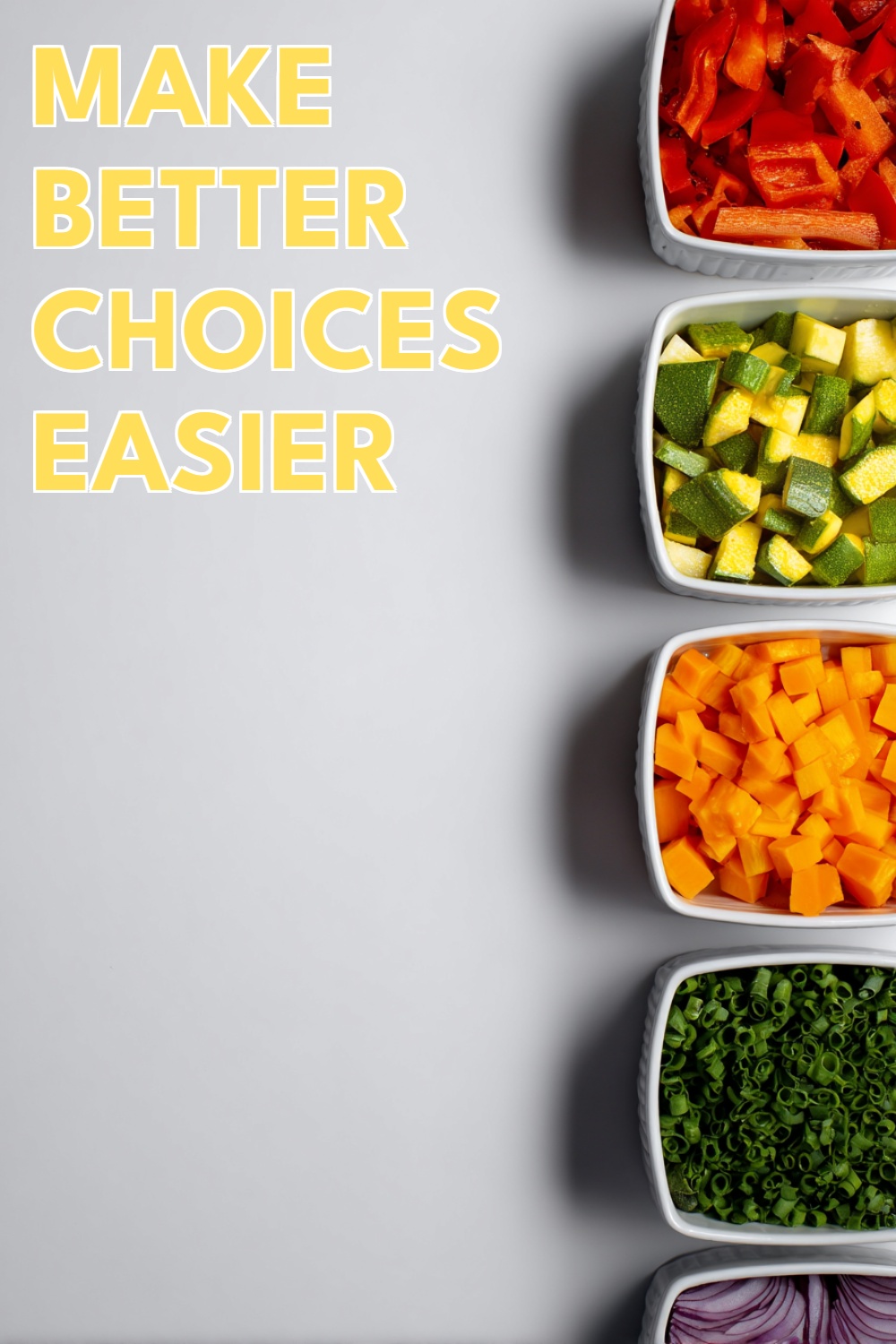
Keep food in the house that is easy to eat when you are hungry and not in the mood to perform healthy eating. Ready-to-eat fruit. Yogurt. Wraps. Eggs. Soup. Microwave rice. Frozen veg. Tinned fish. A loaf of decent bread. Nothing exciting here, and that is partly the point.
It also helps to decide in advance what counts as “good enough”.
Not your best day. Not the version where you meal prep for the week in glass containers and feel very organised. Just the basic version that still moves things in the right direction.
For example:
- breakfast with protein
- lunch that is not just beige snack food
- one proper meal in the evening, even if it is simple
- something resembling a vegetable most days
That is boring. Boring is useful.
Tiny fallback habits help as well. If you cannot face cooking, make the easier healthy thing instead of the easiest unhealthy thing. If you want takeaway, eat something small first so you are not ordering while ravenous. If afternoons are your weak point, have a planned snack instead of pretending you will somehow rise above biology.
Pay attention to the moment before it goes wrong
People often only notice after the fact. I ate rubbish again. I had no control.
Usually there was a moment before that. Not a dramatic one. Just a little turning point.
You got too hungry.
You got stressed.
You started thinking you had already messed up the day.
You saw the food and had that internal shrug.
That bit is worth noticing.
You do not need to journal for an hour about it. Just catch the pattern. This keeps happening when I skip lunch. This keeps happening when I work late. This keeps happening when I tell myself I will be “good” and then inevitably want something more satisfying.
Once you can see the pattern, you can do something practical with it.
Start smaller than you think you need to
A lot of eating problems get worse because people try to fix all of them at once.
They are going to stop snacking, cook every night, quit sugar, drink more water, eat more protein, and become one of those people who always has chopped carrots in the fridge.
By Thursday they are back to grabbing whatever is around and feeling bad about it.
Pick one thing that would genuinely make your days easier.
Not theoretically healthier. Easier.
Maybe it is eating something decent before 11 am. Maybe it is buying two reliable lunches for work instead of winging it. Maybe it is having a default dinner for tired evenings.
Do that first. Get it solid. Then worry about the rest.
If you know what to eat but still do not do it, I would not take that as proof that you are hopeless. Usually it just means your current setup is asking too much of you at the wrong moments.
Sort those moments out, even a bit, and eating better gets much less dramatic.