
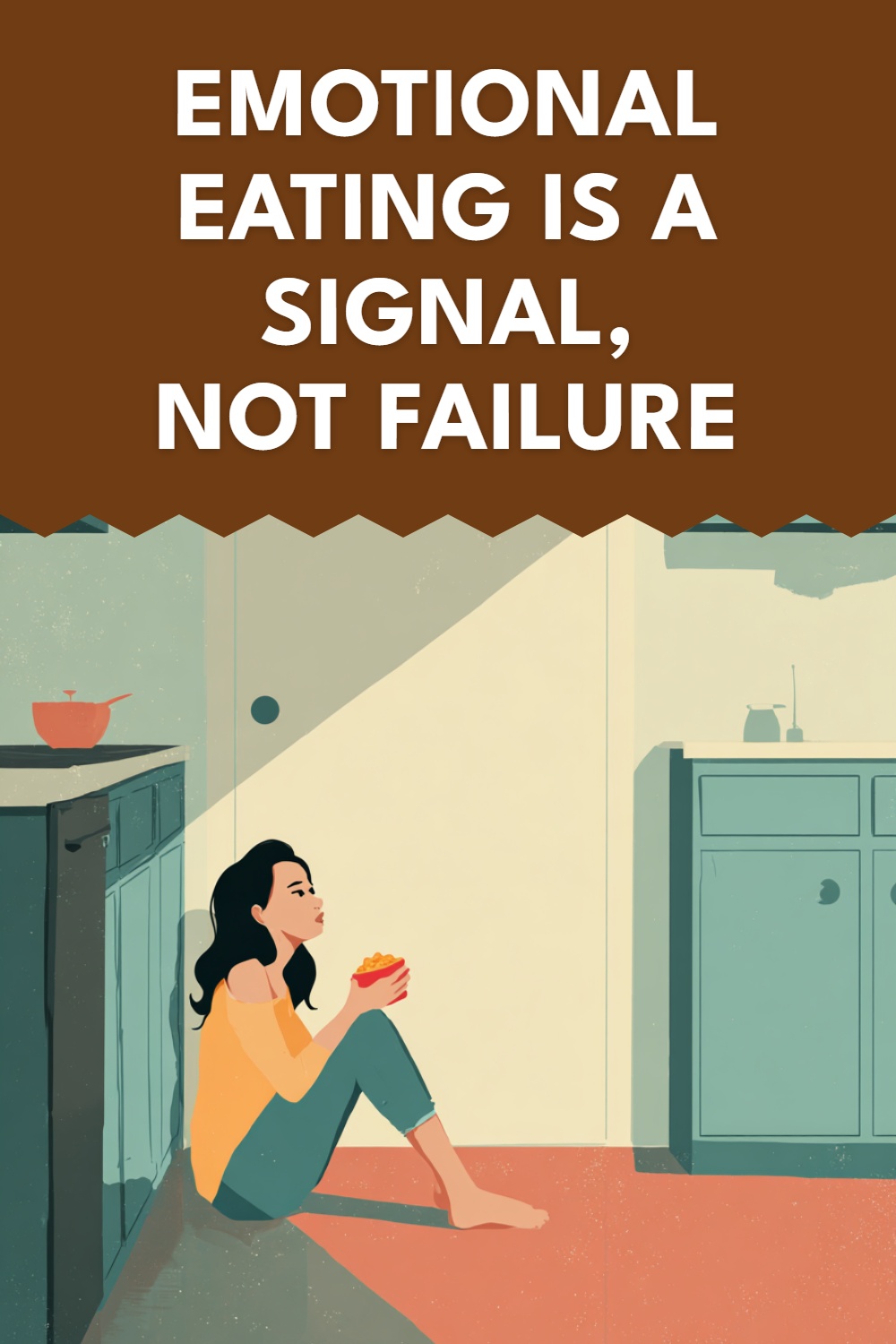
Emotional eating is often treated as something that needs to be stopped, fixed, or controlled.
People talk about it as if it’s a flaw. Something to overcome. Something that proves you lack discipline or self-control.
If you’ve ever eaten when you weren’t physically hungry and then felt guilty about it, you’ve probably seen it this way too.
But emotional eating is not the real problem.
The problem is how we understand it and how we respond to it.
Why emotional eating gets so much blame
Emotional eating is easy to point at because it’s visible. You notice the food. You notice the moment you eat more than you planned. You notice the loss of control.
What you don’t see as clearly is everything that led up to it.
Stress.
Fatigue.
Mental overload.
Restriction earlier in the day.
Pressure to eat “well”.
Food becomes the thing that gets blamed because it’s the final step in the chain.
That doesn’t mean it’s the root cause.

What emotional eating actually is
At its simplest, emotional eating is using food to regulate how you feel.
That might be stress after a long day.
Boredom in the evening.
Loneliness.
Overwhelm.
Even relief.
It’s not usually a conscious decision. Most of the time it happens automatically, before you’ve had a chance to think it through.
And it’s not random.
Emotional eating is a learned response. At some point, food helped in a moment when you needed comfort, distraction, or relief. Your brain remembered that.
That doesn’t make you weak. It makes you human.
Why trying to stop emotional eating often makes it worse
Most advice around emotional eating focuses on control.
Stop doing it.
Distract yourself.
Use willpower.
Avoid trigger foods.
These approaches sound sensible, but they often backfire.
When you tell yourself you must not eat emotionally, you create pressure. Pressure turns food into a battle. Battles increase stress, and stress makes emotional eating more likely.
Restriction plays a role too. When foods are off-limits, they become more mentally charged. That charge doesn’t disappear just because you try to ignore it.
Shame adds another layer. If you judge yourself every time emotional eating happens, you train your brain to associate food with guilt. That emotional weight makes the cycle stronger, not weaker.
Trying harder is rarely the solution here.
Emotional eating is information, not failure
A more useful way to look at emotional eating is as a signal.
It often points to something else that needs attention.
That could be physical. Many people emotionally eat more when they have not eaten enough earlier in the day. Skipped meals and under-eating make the body more sensitive to stress and cravings.
It could be mental. Decision fatigue, constant pressure, and feeling “on” all day leave very little capacity by the evening.
It could be emotional. Stress, loneliness, or feeling disconnected from rest or enjoyment can all show up through food.
Emotional eating is rarely the problem by itself. It’s usually a response to something unmet.
Why food becomes the default coping tool
Food is easy.
Food is available.
Food works quickly.
It calms the nervous system. It provides comfort. It creates a short pause in the day.
When you’re tired or overwhelmed, your brain looks for the fastest relief. Food often wins because it’s familiar and reliable.
That doesn’t mean it’s the only option. It just means it’s the one your brain knows best right now.
Understanding this removes a lot of unnecessary self-criticism.
What actually helps instead
There is no single trick that makes emotional eating disappear. Anyone promising that is oversimplifying something complex.
What does help is changing the conditions around it.
Support the body first
One of the most overlooked pieces is regular, adequate eating. When your body is under-fuelled, emotions hit harder and self-control drops.
Eating consistently during the day reduces the intensity of emotional eating later. This alone can make a noticeable difference.
Reduce pressure around food
When food feels less charged, emotional eating often softens.
This means easing off rigid rules, labels like “good” and “bad”, and the idea that one eating moment defines your progress.
When food feels safer, your brain doesn’t cling to it as tightly.
Notice patterns without judgement
You don’t need to analyse every episode, but gentle awareness helps.
When does emotional eating tend to show up?
After long days?
When you are overtired?
When meals have been rushed or skipped?
The goal is not to catch yourself out. It’s to understand the pattern.
Understanding gives you options.
Create pauses, not rules
Trying to stop emotional eating outright usually creates resistance. Creating a small pause can be more helpful.
A pause does not mean denying yourself food. It means checking in briefly.
Am I hungry, tired, stressed, or just overloaded?
Sometimes you will still eat. That’s fine. The pause itself builds awareness over time.
Why consistency matters more than control
Emotional eating often settles when life feels more predictable.
Regular meals.
Simple routines.
Reduced decision-making.
Consistency creates safety. Safety reduces the need for coping through food.
This is why approaches that focus on habits and structure often help more than those that focus on control.
You’re not trying to force yourself to behave differently. You’re changing the environment around the behaviour.
What progress with emotional eating actually looks like
Progress here is often quieter than people expect.
Emotional eating may still happen. The difference is that it feels less intense. There is less guilt afterwards. Recovery is quicker.
You stop spiralling.
You stop labelling yourself as broken.
You move on with your day.
That is real progress.
Emotional eating doesn’t need to vanish for your relationship with food to improve.
A calmer way forward
Emotional eating is not a sign that something is wrong with you. It’s a sign that something needs attention.
When you stop treating it as the enemy and start responding with curiosity and support, the whole dynamic shifts.
Less pressure.
Less shame.
More stability.
Change happens when you work with your mind and body instead of fighting them.
And that’s when emotional eating starts to loosen its grip, without you having to force it.